The Underwood No. 5: How One Machine Set the Century's Standard
Between 1900 and 1930, the Underwood No. 5 was not simply the best-selling typewriter. It was the reason the modern office keyboard exists in the shape it does.
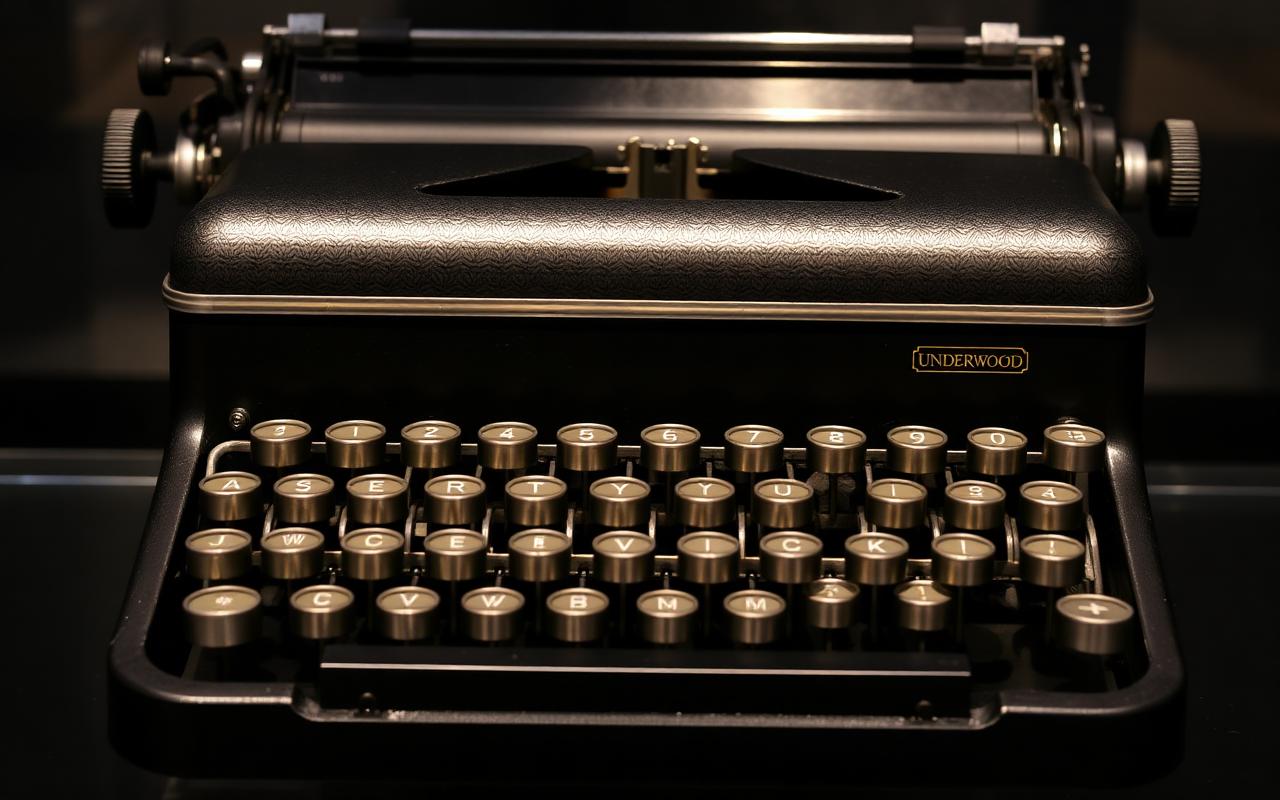
Look at almost any photograph of a newspaper city room between 1905 and 1935 and you will see the same machine: a squared black cast-iron desk typewriter with two upright ribbon spools and a paper table sloped back like the roof of a small house. That is the Underwood No. 5. It was so completely dominant in its era that even a century later, when a set decorator needs a shorthand for "old typewriter", it is the shape they reach for.
The story of how a single model reached that position is a story about seeing a small feature clearly, and then executing everything around it.
The visible-writing problem
Every commercial typewriter in the 1890s printed onto the underside or the far side of the platen. The writer could not see what had been typed until the paper was rolled out or the carriage was lifted. This was accepted as an inevitable limitation, in the way that early aeroplanes accepted their inability to bank steeply. Then Franz Xaver Wagner, a German engineer working in New Jersey, patented a mechanism in which the typebars struck the front of the platen from below and in front, so the writer could read the last line the moment it was typed.
Wagner sold the design to John T. Underwood, a ribbon and carbon-paper manufacturer whose family had supplied consumables to Remington for decades. Underwood released the resulting Model 1 in 1896 and iterated rapidly through the No. 2, 3, and 4. The No. 5, introduced in 1900, refined the design into what would become the definitive front-strike office standard.
Why it won
Visible writing alone would not have been enough. The Underwood No. 5 also delivered several practical advantages that were less noticed at the time but that turned it into a machine offices could not do without.
The keyboard was arranged in the QWERTY layout that the Remington No. 2 had introduced in 1878, but the Underwood's key spacing, throw depth, and return force were calibrated for speed rather than deliberation. Touch typists trained on the Underwood No. 5 set records that older machines could not match, and typing schools began building their curricula around it.
The chassis was manufactured with tolerances that made service predictable. A trained repair technician could disassemble and reassemble a No. 5 in a single sitting, with parts that would fit any other machine of the same model regardless of manufacturing year. This mattered enormously to businesses buying dozens of typewriters and maintaining them for two decades of daily use.
And Underwood's factory in Hartford, Connecticut, ran on a scale that no competitor matched. By 1910, production had passed several hundred thousand machines per year. Prices came down. Reliability came up. The market answered the way markets do.
Design details worth knowing
Several small features distinguish the No. 5 from the earlier models and from imitators.
- Four rows of keys, forty-two characters. Later variants added a fifth row for numerals and reduced key throw, but the classic four-row layout is the icon.
- Glass keytops with metal rings. The rings prevented the paper key labels from lifting. Later plastic keytops appear on the very last production runs and are less prized by collectors.
- Backspace and margin release. Introduced in a form that would be copied by every subsequent office typewriter.
- Ribbon selector for two-colour ribbons. Black-and-red ribbons were novel in 1900 and standard by 1905, largely because Underwood made them practical.
The paint plate was a hard black japan finish with gold decals. Untouched examples show remarkably little decal loss because the japan finish outlasted almost every wear pattern short of decades of daily use.
Where the model went
By 1930, front-strike visible-writing typewriters were universal. Every major manufacturer had introduced its own version, and the Underwood No. 5's specific advantage evaporated. Underwood introduced electric models, updated the portable line, and eventually merged with Olivetti in 1959. The No. 5 quietly ceased production; the factory tooling was retired; the design became a piece of industrial archaeology.
But the machine did not disappear. It was too well built. Millions of Underwood No. 5s survived their working lives and passed into estates, junk shops, film props departments, and eventually the collector market. In 2025, a No. 5 in good working order remains among the easiest and cheapest excellent-quality vintage typewriters a beginner can acquire, precisely because so many were made and so many survive.
Collecting notes
- Serial numbers below 1,000,000 date from before 1913 and command a modest premium, particularly if the machine retains its original ribbon spools.
- Rare typefaces — italic, elite, foreign-language variants — appear occasionally and can double the price of an otherwise ordinary machine.
- Original wooden shipping case with brass corners is exceptionally rare and valued for its own sake.
- Repaints are common and always downgrade the value; original japan finish, however tired, is preferred over a fresh gloss respray.
The Underwood No. 5 is the machine to start a collection with, to teach a beginner on, and to sit in the corner of an office as a working reminder of the century that built it. Nothing in the hobby is more common. Nothing is more foundational.
Estimates run from three to five million, depending on how variants are counted. Common survivors number in the hundreds of thousands.
Cheap and abundant, so unremarkable examples sell for little. Excellent-condition original-decal machines with matching serial-numbered cases hold value.
Almost always. The design is over-engineered and forgives decades of neglect after a proper cleaning.
This article is original writing for The Ribbon & Platen and may not be reproduced without permission. Sources consulted:
- Franz Xaver Wagner US Patents 523,698 and 587,796
- Wilfred Beeching, 'Century of the Typewriter' (1974)