The Hermes 3000: The Writer's Machine From the Alps
Manufactured by Paillard in the Swiss Jura from 1958 to 1975, the Hermes 3000 is the portable that Larry McMurtry, Sam Shepard, and Jack Kerouac all reached for. Curved, seafoam, quiet, and precise as a watch.
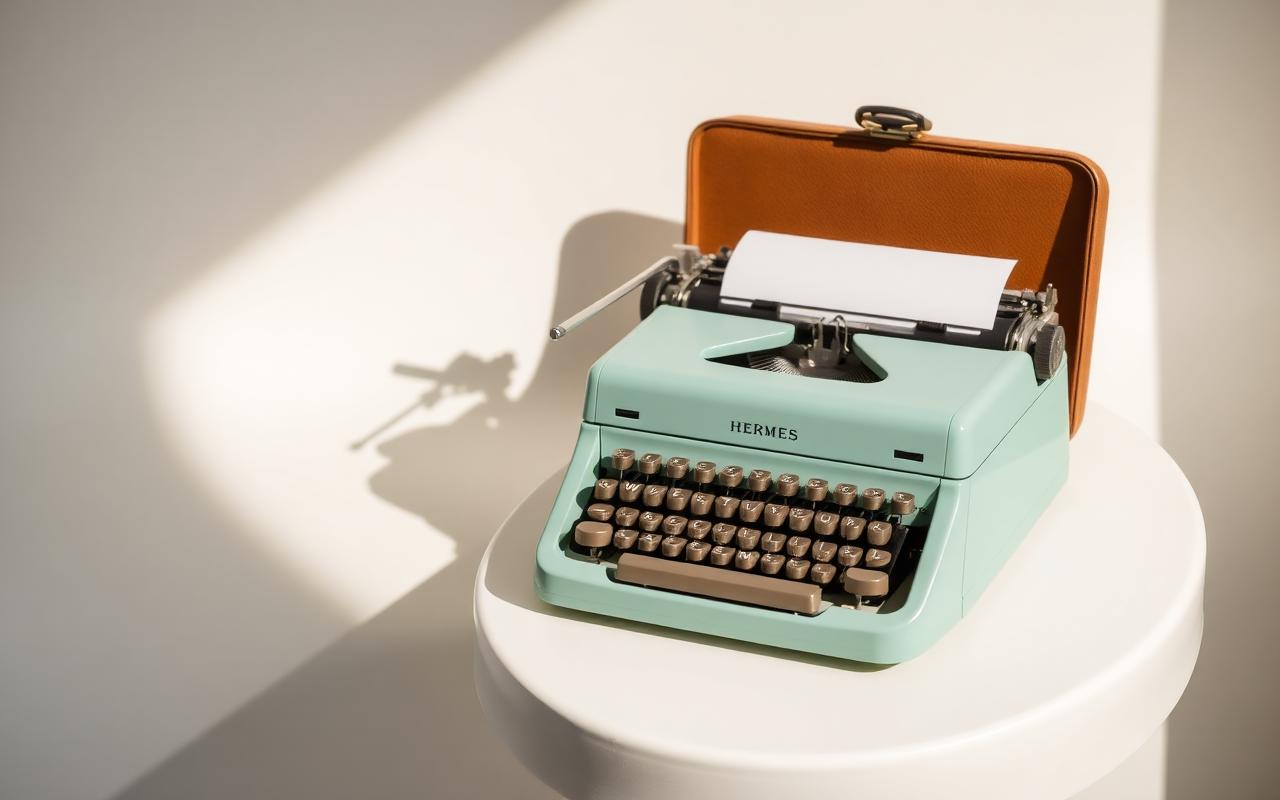
In a hobby full of legendary portables, the Hermes 3000 has a peculiar status: everyone agrees it is exceptional and no two people quite agree on why. Some point to the keyboard feel, some to the elegant curved bodywork of the early models, some to the Swiss engineering that gives every mechanism the tolerance of a fine watch. The truthful answer is that the Hermes 3000 combined those things in a machine that felt, in the hand and under the fingers, unlike any other portable of its era.
Paillard and the Sainte-Croix tradition
Paillard SA was a Swiss precision-manufacturing firm founded in 1814, best known through the nineteenth century for music boxes. In the 1920s the company pivoted into the emerging typewriter market and launched the Hermes brand — named for the Greek messenger god — in 1923. The Hermes Baby of 1935, an ultra-portable barely thicker than a book, established the company as an engineering leader; the Hermes 2000, released in 1938, established Hermes as a serious writer's machine.
The Hermes 3000 arrived in 1958 as the successor to the 2000 and the flagship of the Paillard portable line. Design responsibility was shared between the Sainte-Croix engineering team and the industrial designer Jean Prevost, whose curved body was as much a piece of Swiss modernism as anything in the Alps at the time.
The first-generation body (1958–1966)
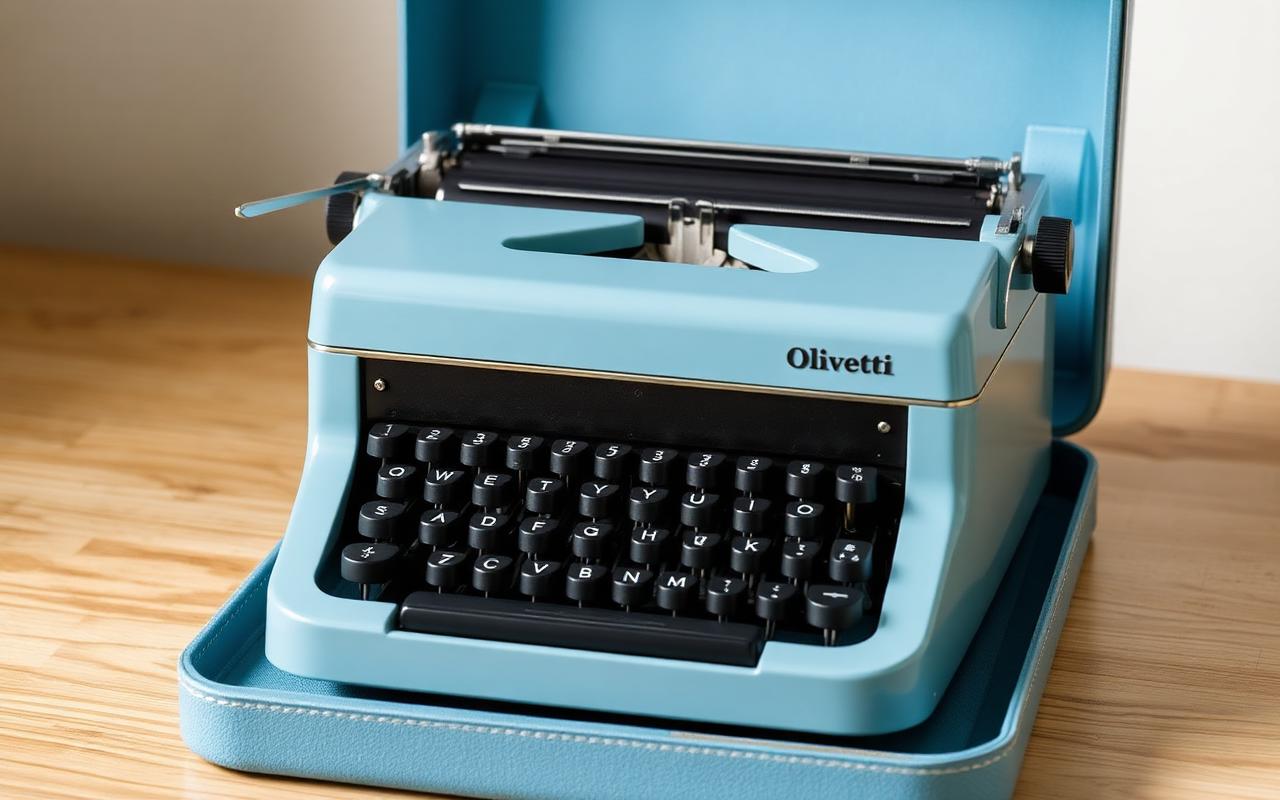
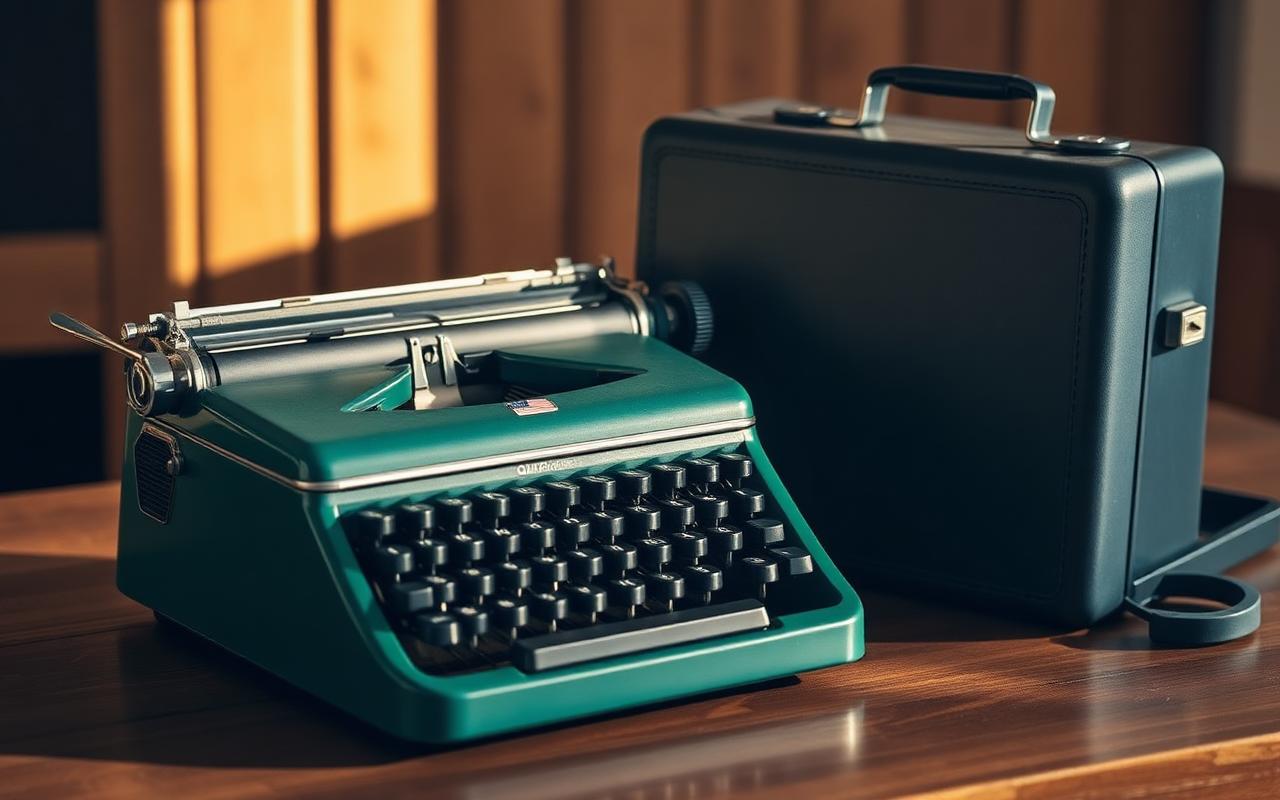
Nothing in the portable typewriter world looks quite like a first-generation Hermes 3000. The body panels are gently curved along every axis, giving the machine a soft, almost aerodynamic profile. The default colour was a distinctive seafoam green that Hermes marketing called "menthe" and that has never quite been imitated by any other manufacturer. Occasional variants in beige, grey, and sand appear; a rare white "Media 3" variant was sold in Europe as a school machine.
The keyboard is quiet. Not silent — no portable is silent — but noticeably quieter than a comparable Olympia or Olivetti, because Hermes engineers built rubber dampers into the segment and the segment lift. This mattered enormously to writers in shared apartments and hotel rooms, and it is part of why so many novelists chose the machine.
The second-generation body (1966–1975)
The second-generation Hermes 3000 replaced the curved body with a squarer, more angular design that better fit the visual language of the late 1960s. The mechanism improved in small ways — the escapement was refined, the ribbon reversal made more reliable, the shift smoothed — while the fundamental engineering remained.
Collector opinion on the two generations divides cleanly. Aesthetically the first generation is more distinctive and holds higher value; mechanically the second generation is slightly better, and some daily writers prefer its firmer feel.
Why writers chose it
Sam Shepard used a Hermes 3000 into the 2000s and reportedly bought spares as insurance against never having to switch. Larry McMurtry famously typed all of Lonesome Dove on a Hermes 3000. Jack Kerouac used one late in his life. The list of professional writers who owned a 3000 at some point runs to hundreds.
The reason is not mystical. Long typing sessions on a Hermes 3000 are less fatiguing than on almost any other portable, because the keyboard feedback is uniform across the whole keyboard and the return force is calibrated to match. Writers who type for eight hours in a day notice this in a way that occasional users do not. And once a writer had found the machine that worked for them, they tended not to change.
Buying and maintaining
The Hermes 3000 is not a bargain machine. A first-generation seafoam 3000 in G2 condition regularly clears three to five hundred dollars in the current market, and museum-quality examples with original consumables, case, and dust cover push higher still. Second-generation models are more affordable, often in the two hundred to three hundred dollar range for equivalent condition.
Common concerns:
- Segment lubrication. Paillard used a specific grade of light grease at the segment that ages poorly. First service after decades of storage almost always requires a segment clean.
- Rubber feet. Original rubber feet flatten and become sticky. Replacement kits are widely available.
- Case leather. Both generations shipped with a distinctive fabric-covered case. Cases are surprisingly durable but the handle stitching often needs re-sewing.
- Ribbon. Universal half-inch ribbons fit the standard Hermes metal spools without adaptation.
Where the story ends
Paillard's typewriter division suffered through the 1970s as electric machines and eventually electronic typewriters cut into the mechanical portable market. Hermes 3000 production ended in 1975. Paillard exited the typewriter business entirely by 1980. The Sainte-Croix factories pivoted toward precision manufacturing for other industries and later into optical components.
The Hermes 3000 outlasted its manufacturer by a wide margin, largely because the writers who owned them refused to give them up. It remains, in 2026, one of the two or three most sought-after mechanical portables in the collector market — expensive, comfortable, quiet, and beautiful, and thoroughly deserving of the reputation.
Yes, by portable standards. G2 examples typically start at three hundred dollars in the US and higher in Europe; the desirability has held prices up for two decades.
First generation for aesthetics and collector value; second generation for daily writing and marginally better mechanical reliability.
A slightly stripped-down 3000 variant sold in some European markets. Same mechanism, simpler trim, lower price today.
This article is original writing for The Ribbon & Platen and may not be reproduced without permission. Sources consulted:
- Musée CIMA, Sainte-Croix, Paillard exhibit notes
- Sam Shepard, interview with the Paris Review, 1997