Shipping a Typewriter Without Damage: A Packing Method That Actually Works
One in seven typewriters shipped worldwide arrives damaged. The techniques that eliminate almost all of those failures are well known, cheap, and rarely used by amateur sellers. Here is what to demand.
The typewriter you bought from a seller two thousand miles away is now in the hands of an international logistics network that will treat the box as though it weighs one kilogram, is unbreakable, and can be thrown from a moving vehicle if the schedule requires it. Any packing method that assumes gentle handling is a plan to be disappointed.
The good news is that reliable packing has been figured out and is well within the reach of any careful seller. The bad news is that most amateur sellers skip the important steps. As a buyer, your job is to demand the correct method before the machine ships.
The failure modes
Two types of impact account for almost all shipped-typewriter damage.
End-on drop with an unrestrained carriage. The box lands on one end. Inside, the carriage slams against its stop with enough force to bend the carriage rail or crack the mainspring case. This is the single most common shipping failure and always avoidable.
Face-down drop onto the segment. The box lands on the top face where the ribbon spools sit. Type slugs are pushed backward into the segment; typebars bend; the segment itself may crack in extreme cases.
Everything below is designed to prevent these two impacts.
The five packing rules
Immobilise the carriage. Before packing, engage the carriage lock if the machine has one. If it does not, wedge a folded strip of cardboard between the carriage and each of the machine's frame stops so the carriage cannot slide during transit. On portables without any lock, this alone prevents most damage.
Pack the segment. Fold a strip of soft paper into a wedge and slide it between the type slugs and the ribbon vibrator so the typebars cannot move forward. Do not use tape; adhesive residue on a segment is a slow-to-clean problem.
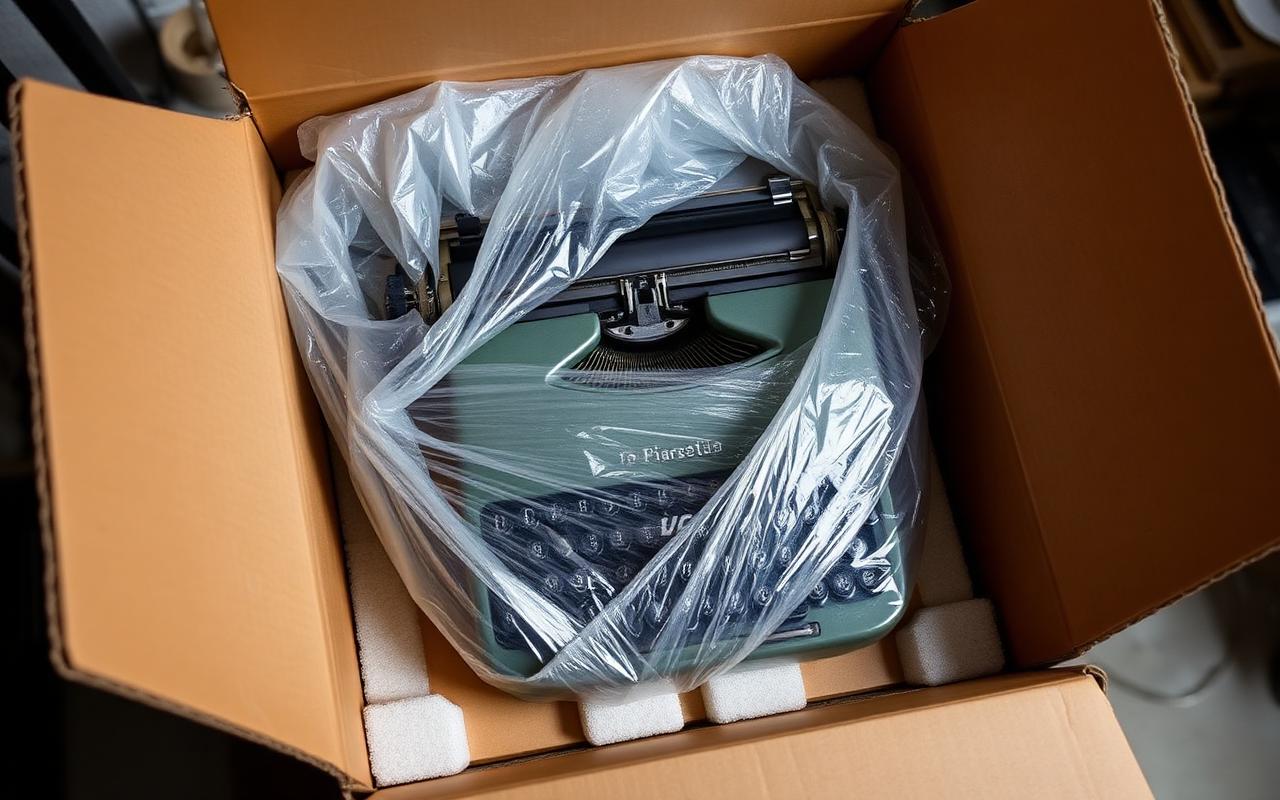
Wrap the machine in soft material. A blanket, several layers of bubble wrap, or a thick roll of packing paper. The machine should not be able to shift within its wrapping.
Use the original case as the inner container. If the machine has a case, wrap the machine, place it in the case, latch the case, and treat the closed case as the item to be packed.
Double-box. The cased machine goes inside a slightly larger outer box, with a full 5 cm (two inches) of foam or crumpled paper cushioning on all six sides between case and outer box. The outer box takes any impact; the inner space isolates the case from that impact.
Materials
None of the required materials are exotic. All are inexpensive.
- Two sturdy corrugated boxes, one nested inside the other with 5 cm clearance on all sides.
- Two rolls of large bubble wrap.
- One bag of packing peanuts or foam sheets for the outer void.
- Painter's tape for restraining internal parts.
- Strong packing tape for closing the boxes.
A well-packed typewriter shipping box typically weighs about 7 to 8 kilograms (15 to 18 pounds) for a portable, considerably more for a desktop standard. Shipping costs reflect this, and low-cost shipping is often shorthand for insufficient packing.
What to demand as a buyer
Before you pay, ask the seller three questions.
- Will the machine ship in double boxes with cushioning between?
- Will the carriage be locked or wedged?
- Will the machine be insured for its full purchase price?
If the answer to any of these is no or uncertain, either walk away or offer to pay a modest packing supplement. A seller who cannot answer these questions confidently is a seller whose machines arrive damaged.
Photographs of the packed machine, sent before the box goes to the carrier, are useful. Any seller unwilling to send them is telling you something.
The insurance question
Shipping insurance is cheap and worth carrying on any machine valued above about $100. In the US, USPS and UPS both offer declared-value insurance at roughly $1 per $100 of value. This does not prevent damage but transfers the loss to the carrier, and the claim process — while tedious — usually pays out for machines packed correctly and photographed before shipping.
An uninsured $400 typewriter that arrives damaged is a $400 loss. Buy insurance.
When the box arrives
Photograph the box before opening it, especially if there is any external damage. Photograph again as you unpack, at each stage. This documentation is what insurance claims run on.
Do not assume a machine is undamaged because it looks fine. Test-type before signing off on the shipment. Damage that is only apparent under load — bent typebars, cracked carriage rails, subtly bent frames — will show up in the first hour of use, not in the first minute of unpacking.
If damage is present, contact the seller and the carrier immediately, both in writing. Keep all packing materials for inspection. Do not throw anything away until the claim is resolved.
The rare disaster
Even perfectly packed machines occasionally arrive damaged. Shipping is probabilistic. If you buy remotely often enough, you will eventually receive a damaged machine no matter how well packed it was. This is a cost of buying at scale, not a failure of any individual transaction.
Handled with care, the damage is usually reparable and the insurance covers the cost. Handled with the wrong reflex — anger at the seller, refusal to accept partial damage as a fact of the hobby — the same event becomes a permanent grievance. Choose the calmer response and the hobby stays sustainable.
Every experienced remote buyer has a shipping horror story. Every one of them also has fifty happy deliveries. The odds are with you if you pack carefully, insure, and buy from sellers who take the process seriously.
Only inside a proper outer box with additional cushioning. The case alone is not shipping protection.
About one percent of the declared value for domestic ground shipping in the US and EU. Cheap enough that skipping it is false economy.
Yes. A ribbon that comes loose in shipping stains the interior of the case.
This article is original writing for The Ribbon & Platen and may not be reproduced without permission. Sources consulted:
- Author's shipping-loss records, 2018–2025
- US Postal Service handling standards, published 2024