In-Person Inspection: The Ten-Minute Checklist That Prevents Regret
The seller is watching. The other customers are watching. You have ten minutes with a machine you may take home. Here is a routine that fits those constraints and misses nothing that would kill the deal at home.

An in-person inspection is a compressed version of the full bench check. It cannot cover everything a bench session can — no solvent, no tools, no time — but it can identify the faults that would kill the deal at home. A ten-minute routine that catches those is enough to make in-person buying reliably better than remote buying.
Before we begin: three habits make every inspection better. Bring your own paper. Bring a small flashlight. And bring a light attitude — a machine you inspect calmly, and walk away from without agony, teaches you more than one you buy in a rush.
Minute 0 to 1: silhouette and stance
Look at the machine from three metres away. Does it sit square? Is one corner drooping — a broken foot, a bent frame? Does the carriage sit level, or does it tilt? Is the case obviously wrong for the machine? Read the silhouette and note anything that surprises you.
Then approach. Do not touch. Circle the machine once, slowly, at eye level.
Minute 1 to 3: paint, decals, cosmetics
Look at the paint plate under strong light — daylight is best, a small flashlight is acceptable. You are looking for evidence of repainting: paint pooling in screw heads, brush marks on flat surfaces, wrong-colour keys (a repainted machine sometimes has replacement keys that do not quite match), and overspray on the platen or feed rollers.
Original wear is different from repaint wear. Original paint fades and thins gently; repaint chips reveal a different colour underneath, or an unnatural bare-metal edge. Inspect the corners of the machine specifically; these wear most on originals and are usually not touched up by cheap repaints, so a machine with perfect corners and worn central paint is suspicious.
Note the decals. Original decals show the same era of wear as the paint they sit on; replacement decals often look too crisp against faded paint.
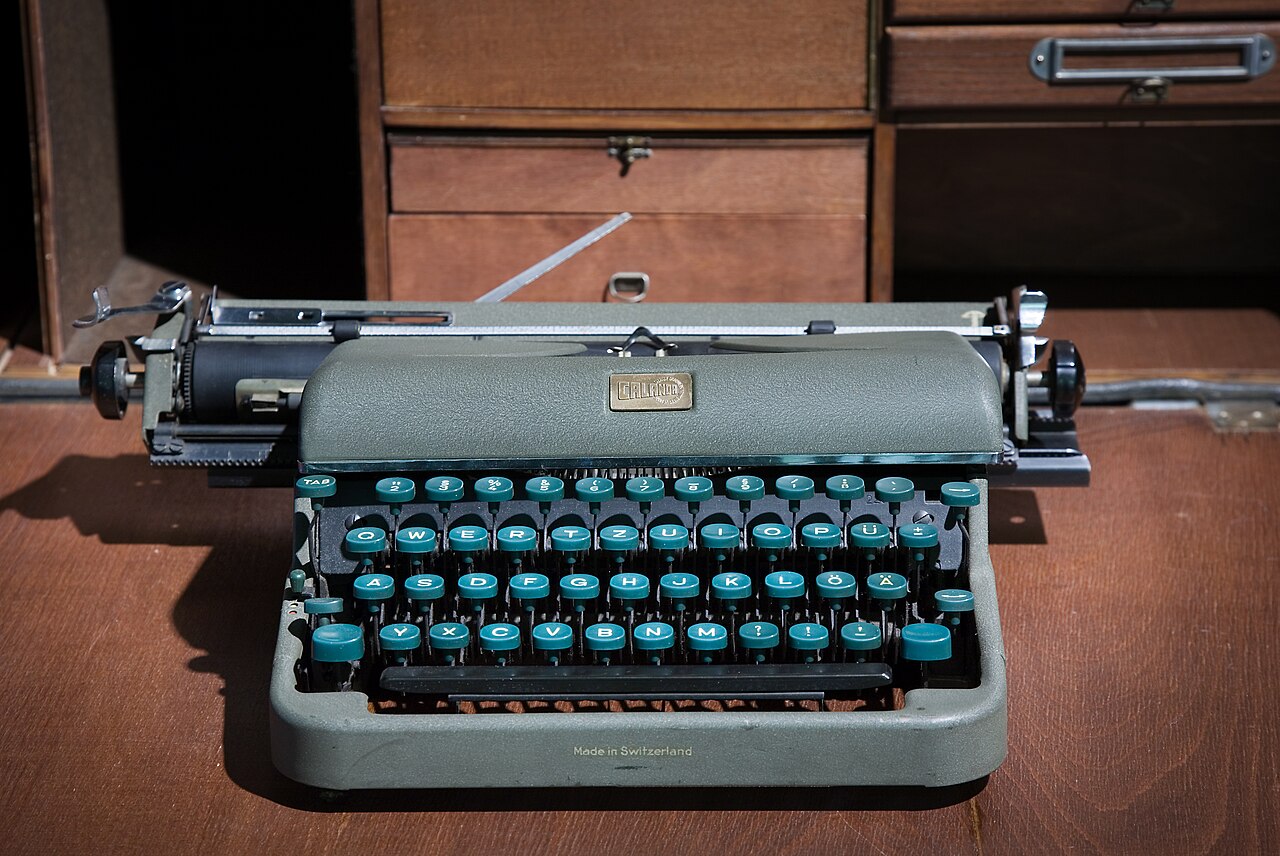
Note the keys. Complete? Original? Unbroken? Glass keys with metal rings are original on most pre-1960 machines; plastic keys on the same machines suggest replacement. Note whether the keys have their intended letters or whether any are mismatched (a common sign of a mixed machine assembled from parts).
Minute 3 to 5: carriage and platen
Now you touch. Two fingers on the carriage return; move the carriage gently right and left across its full range. Feel for grinding (dry rails), sticking (bent rail, seized part), or unusual resistance (weak or broken drawstring). A healthy carriage glides smoothly under light finger pressure.
Press a fingernail into the platen at the front edge, away from where paper would sit. Note the recovery. Comfortable rubber accepts a small dent that vanishes within a second. Hard rubber accepts no dent. This tells you whether you will be spending $200 on a recovered platen before the machine writes cleanly.
Check the ribbon vibrator. Press any key gently. The ribbon should rise in front of the type slug and fall back after. If the ribbon does not rise, the vibrator linkage is broken or disconnected — a common and usually cheap repair, but a fault worth naming.
Minute 5 to 7: the segment
Look down into the segment from above. Every typebar should sit at the same height and lean the same way; the pattern of rest positions should form a smooth arc. A single tall or leaning bar suggests impact damage. A tangled cluster of bars suggests dried grease and a segment cleaning ahead of you.
Press one typebar to the platen by hand and release. It should return under its own spring within about a second. A bar that stays at the platen or drops slowly means dried lubricant; a bar that does not return at all means a broken return spring.
Press three or four different keys firmly, one at a time, waiting between them. Do the bars fall back cleanly? Do adjacent bars sometimes hesitate? Note the pattern.
Minute 7 to 9: the typed test
Now the definitive check. Roll a sheet of paper in — bring your own — and type the alphabet slowly, twice. Lowercase, then uppercase. Then type the numerals and common punctuation.
Look at the sheet. Is every letter present? Are letters missing (broken or bent typebar; if you know which key produced the miss, you know which bar). Are letters printing above or below the baseline (bent typebar)? Are letters leaning (bent shoulder)? Is the impression even and dark, or grey and patchy (dry ribbon)?
Type a short sentence at your normal writing speed. Does the machine keep up? Does the carriage advance one character per keystroke reliably (escapement works)? Does the space bar advance the correct distance (escapement adjustment)?
Note that you are not testing perfection. You are testing whether the faults you see are repairable at home or require professional work.
Minute 9 to 10: case and consumables
Check the case for structural integrity. Latches functional? Handle securely attached? Interior lining intact (a lifted lining scratches the machine)?
Check that ribbon spools are present. Confirm they are the correct spools for the machine (this matters especially for Olivettis). Note the ribbon's condition; a dry ribbon is easily replaced but should be reflected in the price.
Look inside the case pocket for any accessories: instruction booklet, dust cover, spare ribbons, key card. All of these add small amounts of value.
The deal
If everything above passes, the machine is worth serious consideration. If two or three items fail, note them, price the repair in your head, and decide whether the asking price minus that cost is still a fair deal.
Never negotiate more than five percent below asking on a fair price. It insults the seller and, in a small market, follows you. Negotiate meaningfully — twenty percent or more — only when you have identified specific faults that justify the discount, and explain them politely.
Buy, or walk away calmly and mean it. There is always another machine.
Bring your own. A folded sheet of standard letter paper in your bag weighs nothing.
Press a fingernail firmly into the platen. Comfortable rubber accepts a small dent that recovers within a second. Rock-hard rubber accepts no dent at all.
No. In-person inspections stay outside the covers. If a machine needs internal inspection to reveal its condition, walk away.
This article is original writing for The Ribbon & Platen and may not be reproduced without permission. Sources consulted:
- Field notes from 400+ in-person inspections
- Correspondence with three US repair-shop owners