The Olympia SM Family: A German Portable in Seven Acts
The SM series ran from 1949 to 1972 across seven numbered generations. Each generation solved a problem the previous one had created. Read together they are a compact history of the post-war portable.
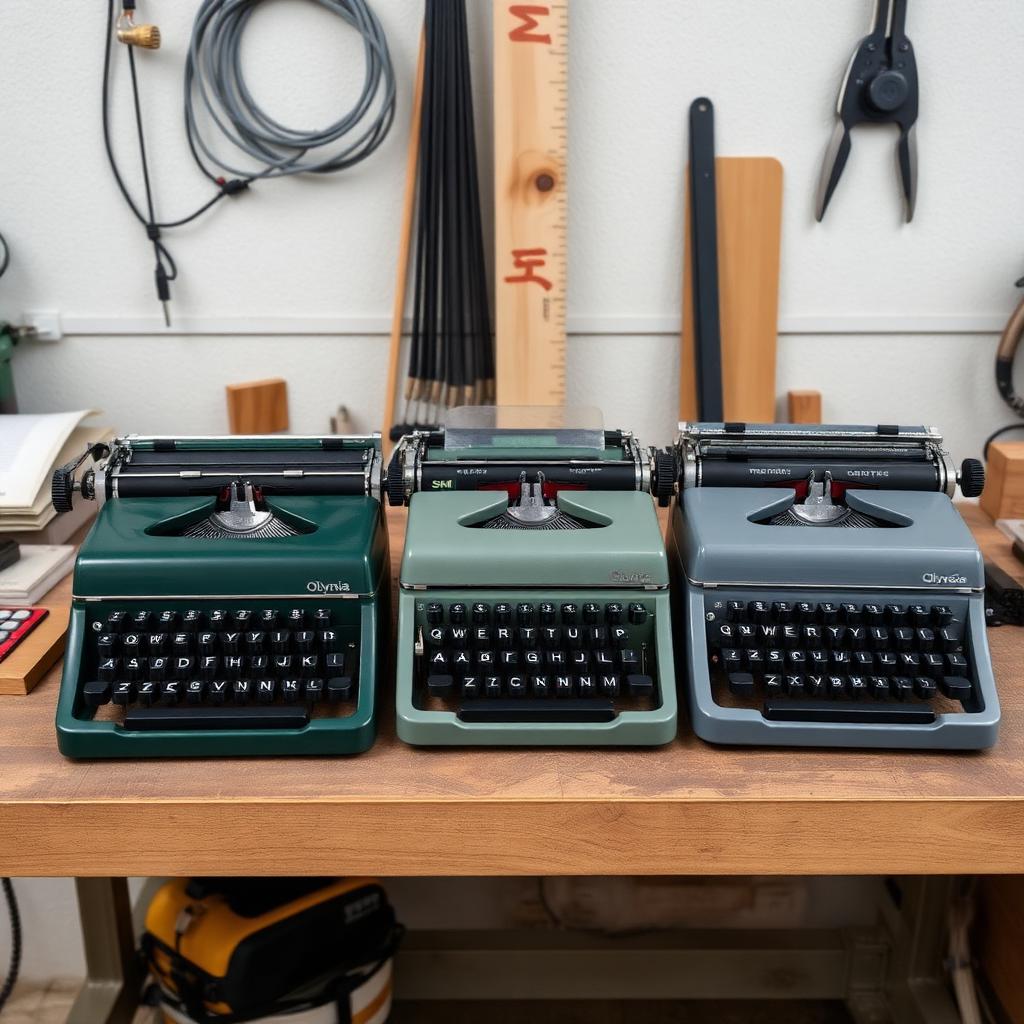
The Olympia SM is the machine most European writers of the 1950s and 1960s learned to type on, and the machine most collectors of a certain age still describe as "the one that got away." Its story is short — twenty-three years, seven numbered generations — but it maps closely onto the history of the German portable typewriter as a whole. Each generation was Olympia's answer to a specific commercial pressure, and reading them in order is like reading a compressed history of post-war European manufacturing.
The reconstruction: SM1 (1949–1952)
Olympia lost its Erfurt plant to the Soviet zone in 1945. The company that emerged in Wilhelmshaven a few years later had to prove, quickly, that it could still build a machine worth buying. The SM1 was that proof. It borrowed heavily from the pre-war Olympia Elite portable, kept the segment shift, and added a slightly modernised body. Production was small; surviving examples are uncommon and command a premium among collectors who value first-of-series machines.
The definition: SM2 (1952–1955)
The SM2 established the shape and feel that would carry through the whole series. Segment shift with a firm return. A ribbon vibrator that lifted crisply and fell cleanly. A carriage return lever with a satisfying weight. Reviewers called it "the German portable" without needing to explain which one they meant.
The peak: SM3 (1955–1960)
If there is a consensus best SM, it is the SM3. Everything the SM2 introduced was refined; nothing yet had been compromised for cost. The body is slightly more sculpted than the SM2, the trim more restrained, and the mechanism has a fluidity that later generations occasionally match but never surpass. Prices for excellent SM3s in Europe now sit at the top of the portable market, above comparable Hermes 3000s in some circles.
The plateau: SM4 (1959–1962)
Olympia introduced tabulator refinements and a slightly wider carriage option on the SM4. Feel and build quality remain very close to the SM3. Collectors who cannot find or afford an SM3 typically settle happily on an SM4 and rarely regret it. The two are often confused at a glance; the giveaway is the paper support geometry.
The refresh: SM5 and SM7 (1961–1966)
The SM5 and SM7 (there was no SM6 — Olympia skipped the number to align with a marketing scheme) added colour options and a slightly restyled body. Mechanically they are essentially SM4s in new clothes. The paint on these generations is exceptionally durable and holds up better than the earlier gloss finishes. If you want a colourful writer's machine — pale blue, mint green, cream — these are the years to look.
The transition: SM8 (1963–1965)
The SM8 has a mixed reputation, mostly unearned. It was the first SM to be built with some cost-reduced components: thinner nickel on some trim, a slightly simplified paper feed. In practice, a well-kept SM8 types indistinguishably from an SM7. The market discount on SM8s is a buying opportunity if you can find an example that was cared for.
The last: SM9 (1965–1972)
The SM9 was Olympia's final SM before the company moved its portable focus to the SG series and, later, to electronic machines. The SM9 sold in large numbers and is the most commonly encountered SM today, especially in Europe. Build quality is honestly a step down from the SM3 — key travel is slightly longer, the shift is slightly heavier, the carriage return has less spring — but the difference is one that only side-by-side comparison reveals. On its own, an SM9 is still one of the better portables ever made.
What links them
Across all seven generations the SM shares a core mechanism family. The segment, the escapement, the mainspring drum, and much of the linkage interchange with only minor adjustment between adjacent generations. This is a practical advantage for restoration: a broken SM7 draw band can be replaced with an SM8 part, and an SM3 mainspring drum will bolt into an SM4 without complaint.
The typing feel across the series is remarkably consistent for a family that spans more than two decades. The SMs are all firm-actioned, precise, and quiet compared to their American contemporaries. Writers who describe an Olympia as "sewing-machine-like" mean it as a compliment — the precision of the action recalls a good domestic sewing machine of the same period, and for exactly the same reasons: German precision manufacturing at scale, aimed at durability rather than novelty.
The historical arc
Read as a single story, the SM series traces the arc of West German manufacturing from post-war reconstruction to the beginnings of Asian competition in the 1970s. The SM1 exists because Olympia had to prove it could still build; the SM9 exists because the world was about to change. In between, for a decade in the middle, the SM was as good as portable typewriters ever got. That is the machine collectors are chasing when they say they want a "good Olympia" — and it is why the SM3 and SM4, more than any other generation, keep quietly climbing in the collector market year after year.
The SM3 (1955–1960) is the widely-agreed peak: excellent action, elegant proportions, before the cost cutting of the SM7 and SM9.
No. The SM8 has a reputation for being 'the transitional model' but examples in good order type as well as an SM7. Buy the condition, not the model number.
Wilhelmshaven, West Germany, throughout the SM run. The later SG models moved production to other plants.
This article is original writing for The Ribbon & Platen and may not be reproduced without permission. Sources consulted:
- Olympia Werke annual reports, 1949–1972
- West German consumer press reviews (Der Spiegel typewriter features, 1957 and 1961)
- Typewriter Database SM serial records