Platen Hardness: When to Live With It, When to Recover
A concrete platen prints crisply but shortens the life of every typebar. A soft platen prints kindly but smears. Here is how to measure what you actually have and decide whether recovery is worth two hundred dollars.
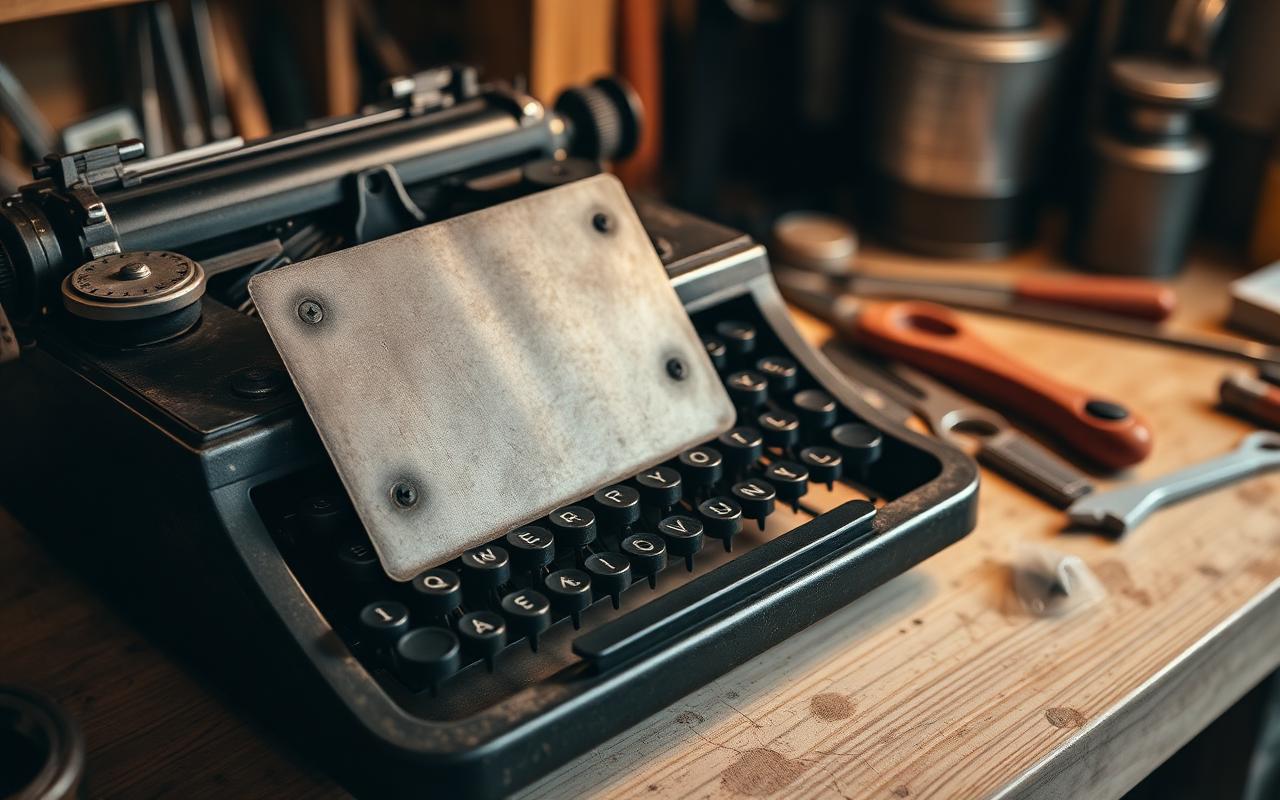
The platen is the second half of every printed character. The type slug supplies the shape; the platen supplies the give. When the give is gone, the machine still prints, but the impression becomes brittle, the sound turns from a soft thump to a bright crack, and every stroke transmits more force back into the segment. Restoration people talk about "recovering" the platen because the underlying steel core is almost always fine; it is the rubber layer bonded to it that has aged into something more like fired clay.
Measuring what you have
The professional test uses a Shore-A durometer, a small spring-loaded gauge that reads rubber hardness on a scale of zero to one hundred. New typewriter platens leave the factory between 82 and 88 Shore-A. A comfortable working range is 85 to 90. From 90 to 94 the machine is loud and starting to print with a haloed edge. Above 94 the rubber is essentially plastic; the machine is fatiguing to type on for more than a page.
If you do not own a durometer, use the fingernail test as a substitute. Press a fingernail firmly into the platen away from where paper feeds. A comfortable platen accepts a small dent that recovers in about a second. A hard platen resists any dent at all. A completely fossilised platen sounds like tapping wood.
The feed rollers behind the platen degrade on the same schedule and cause a different symptom: paper slips, feeds crooked, or refuses to grip at all. When you send the platen out for recovery, send the feed rollers too. Nobody enjoys doing the same shipping twice.
Living with a hard platen
Recovery is not the only answer, and for many machines it is not the right answer. A daily writer benefits from the work; a display piece does not. A common practical middle ground is to place a second sheet of paper behind the primary sheet, giving the type slug a small extra cushion. Two sheets soften the impression, quiet the machine, and reduce stress on the typebars by a surprising margin. Some collectors use a strip of tissue paper as a "packing sheet" instead; the effect is similar.
If the platen is unpleasantly hard but not damaging the machine, you can also lighten your touch. Vintage typewriters do not require the heavy strike a modern touch-typist tends to apply on a laptop. Retraining yourself to type at half the force you use on a keyboard produces a cleaner impression, extends ribbon life, and largely compensates for a mid-range hard platen.
When to recover
Send the platen out when three conditions coincide. First, the machine is one you intend to use regularly; recovery does not pay back on a shelf queen. Second, the machine is worth the investment; a two-hundred-dollar recovery on a fifty-dollar portable rarely makes sense unless the machine has sentimental weight. Third, no simpler intervention has restored acceptable print quality — you have tried a new ribbon, a fresh platen wipe with mild glycerine, and a second sheet of packing paper, and the impression is still poor.
Two shops have long dominated the trade. J.J. Short Associates in the US has recovered platens for decades and returns machines to factory diameter with impressive consistency. In Europe, a small number of rubber-roller specialists — often working primarily with printing-press equipment — handle typewriter platens as a sideline; look for shops that will name their durometer target in writing before quoting.
The shipping problem
The platen core is a slender steel tube with delicate end fittings. It ships poorly if wrapped only in bubble wrap. The correct method is a length of PVC pipe slightly larger than the platen's diameter, capped at both ends with foam, inside a padded outer box. Any specialist worth using will supply a shipping guide when you order; follow it exactly. A bent core is not recoverable.
After the recovery
A recovered platen returns to a specific diameter — usually the factory diameter, occasionally slightly under-sized on machines where a rebuilt paper-feed clearance is preferred. Reinstall carefully, align the paper table, and expect a short break-in period during which the new rubber compresses slightly. Impressions are markedly softer, the machine is quieter, and the typebars stop transmitting a hard shock back into your fingers.
The rubber will not last forever. Modern platen compounds are formulated to hold their hardness for twenty to thirty years under typical use, longer under gentle use in stable humidity. A recovered platen is not a museum artefact; it is a working consumable, like a ribbon, that you can replace again when the time comes.
Ideally yes; the meters are inexpensive. A fingernail test is a rough substitute — a nail should leave a faint dent that vanishes in a second.
USD 150 to 250 per platen at reputable shops in 2025, plus shipping. Feed rollers add another 50 to 100.
Over time, yes. Repeated impact into concrete-hard rubber can bend typebars and wear segment slots faster.
This article is original writing for The Ribbon & Platen and may not be reproduced without permission. Sources consulted:
- J.J. Short Associates, published specifications
- Author's Shore-A logs, 2022–2025